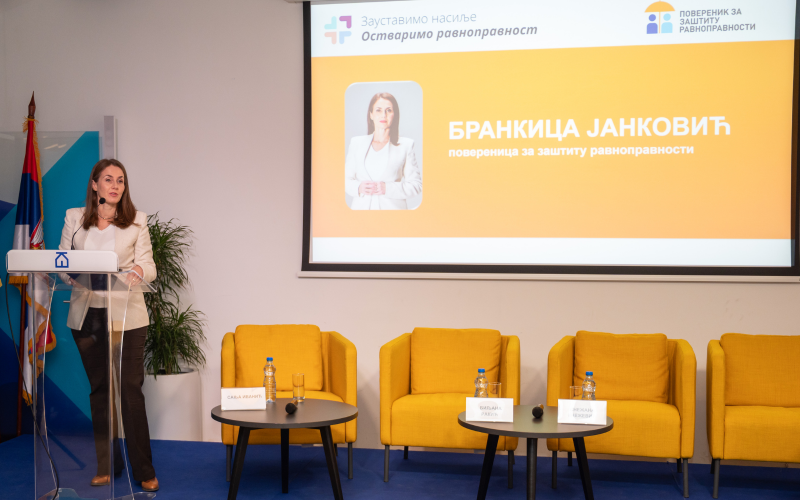
“Presence is allowed, but the voice is limited” – these are the words that best capture the position of women in Serbia, said the Commissioner for the Protection of Equality, Brankica Janković, at the presentation of the Special Report on Discrimination against Women 2015–2025, published by the institution of the Commissioner for the Protection of Equality.
The second Special Report on Discrimination against Women represents a continuation of ong-standing, multi-year institutional monitoring of the position of women and the implementation of anti-discrimination regulations in Serbia. In 2024, nearly 200 complaints were filed on the basis of sex discrimination, the highest number in the past decade. The Commissioner’s practice shows that protection mechanisms do function, but faster procedures, clearer standards, and stronger cross-sector cooperation are necessary for more effective protection.
“Women today are more educated than ever, present in the labor market, in the media, culture, universities, politics, and the digital sphere. Still, presence is not the same as equality. Formal equality exists, but the real position of women is often shaped by invisible yet very firm barriers. Our task is to use facts and law to illuminate the places where practice does not follow legislation, so that equal rights for women become a reality in everyday life,” Janković stated.
According to the findings of the report, the highest degree of inequality remains in the field of work and employment, from the choice of profession, to limited access to certain occupations, wage gaps, and slower advancement, particularly after maternity leave or childcare leave. Sexual harassment is one of the most widespread forms of discrimination at work, and two out of five women have experienced some form of it. Gender-based violence, including femicide, remains the most serious violation of women’s rights and safety, and discrimination is especially present toward women with disabilities, Roma women, women in rural areas, LGBTI+ women, older women, and migrant women. In the area of health care and reproductive rights, serious problems persist, including obstetric violence. In political and public life, numerical representation of women has improved, but often in lower levels of government, while influential positions remain in the hands of men.
The presentation of the Special Report was organized by the Commissioner ahead of the “16 Days of Activism against Gender-Based Violence” campaign, under the symbolic slogan “Tomorrow May Be Too Late,” within the project “Stop Violence – Achieve Equality.”
The event included three panel discussions on improving gender equality, bringing together representatives of state institutions, civil society, and the business sector.
After the presentation of the Special Report, AstraZeneca officially signed the Commissioner for the Protection of Equality’s Equality Charter.